10/24-10/30
Amy Seimetz's SHE DIES TOMORROW // Kelly Reichardt's THE MASTERMIND // Allan J. Pakula's THE PARALLAX VIEW // William Friedkin's BUG
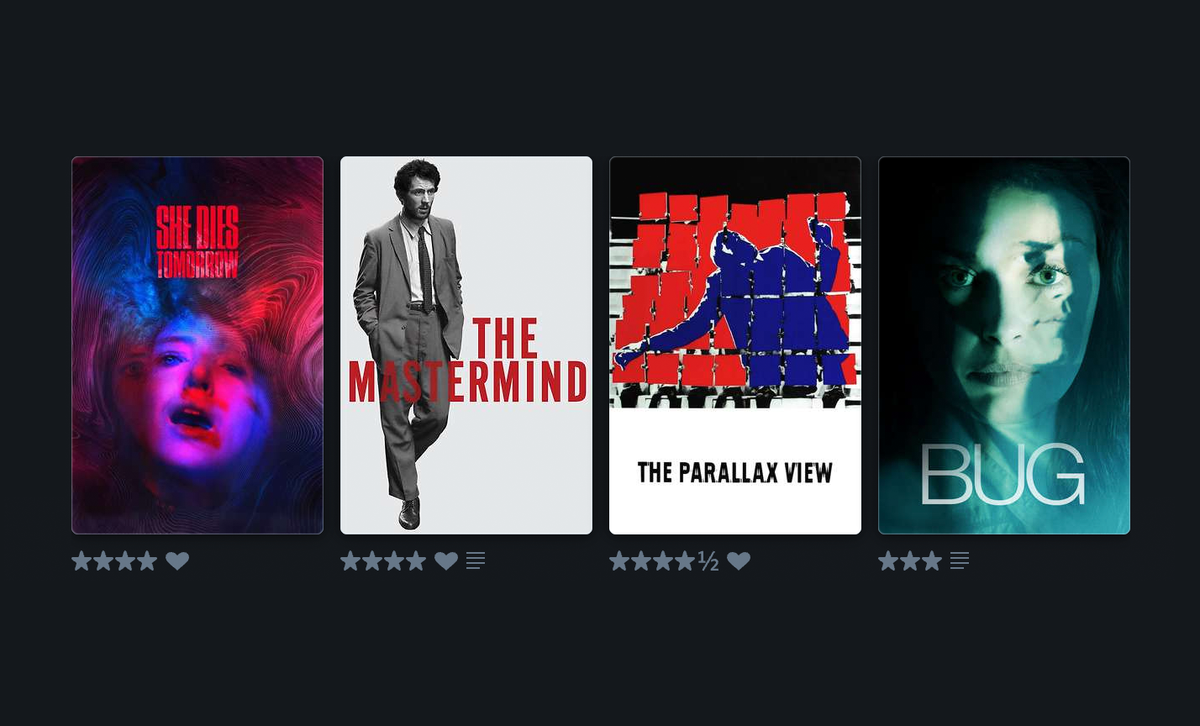
Amy Seimetz's SHE DIES TOMORROW
Kelly Reichardt's THE MASTERMIND
Despite having an art heist at the center of its plot, this film isn't really a "heist film"-- it isn't interested in the mechanics of the heist itself, nor is it really interested in making any special observations about crime (or about art, for that matter). What it is interested in is a particular kind of male haplessness (you could make a good double feature of it with Reichardt's earlier Meek's Cutoff in this regard). Other things it is interested in: the desolate beauty of New England autumn, certain strands of 1970s fashion, the various ways the geometries of large cars can occupy a movie screen, Josh O’Connor's face. Critical claims for the movie's deep political insight seem to me to be a bit overgenerous--and the treatment of Javion Allen's Black character should raise more of an eyebrow in this regard--but there was more than enough interesting microphenomena in every scene (except possibly the very last) to keep me engaged without the need for "big picture" cultural analysis. Bonus points for a surprise Rob Mazurek score??
Alan J. Pakula's THE PARALLAX VIEW
William Friedkin's BUG
[light spoilers]
I know this has its ardent fans, but I couldn't quite get on board with it. Friedkin's direction is fine, but Tracy Letts's script has an overweening fascination with the most colorful and lurid manifestations of paranoid schizophrenia—now, sure, I had the same fascination when I was an 18-year-old with a transgressive streak, but I've long since grown out of it. And having Agnes sort of "catch" Peter's schizophrenia like it's a contagion just doesn't land right for me. [Either she's voluntarily "opting in" to sharing Peter's delusions out of fear of losing him (we hear a lot about her loneliness), or she has her own latent schizophrenic tendencies that get "triggered" by her proximity to Peter—neither option strikes me as great screenwriting or good psychology.] Ashley Judd and Michael Shannon are the saving grace here, though, turning in strong performances which humanize these characters and make them more sympathetic than they've been written to be.
None of this is to say you can't make a good movie about mental illness, or even a good movie about paranoid schizophrenia—Lodge Kerrigan's CLEAN, SHAVEN (1993) comes to mind as a less sensationalist, more solemn treatment of this kind of material, while still containing some ghastly transgressive sequences.