4/17-4/22
Steven Soderbergh's THE CHRISTOPHERS // Werner Herzog's FATA MORGANA // Bi Gan's RESURRECTION // Werner Herzog's LITTLE DIETER NEEDS TO FLY
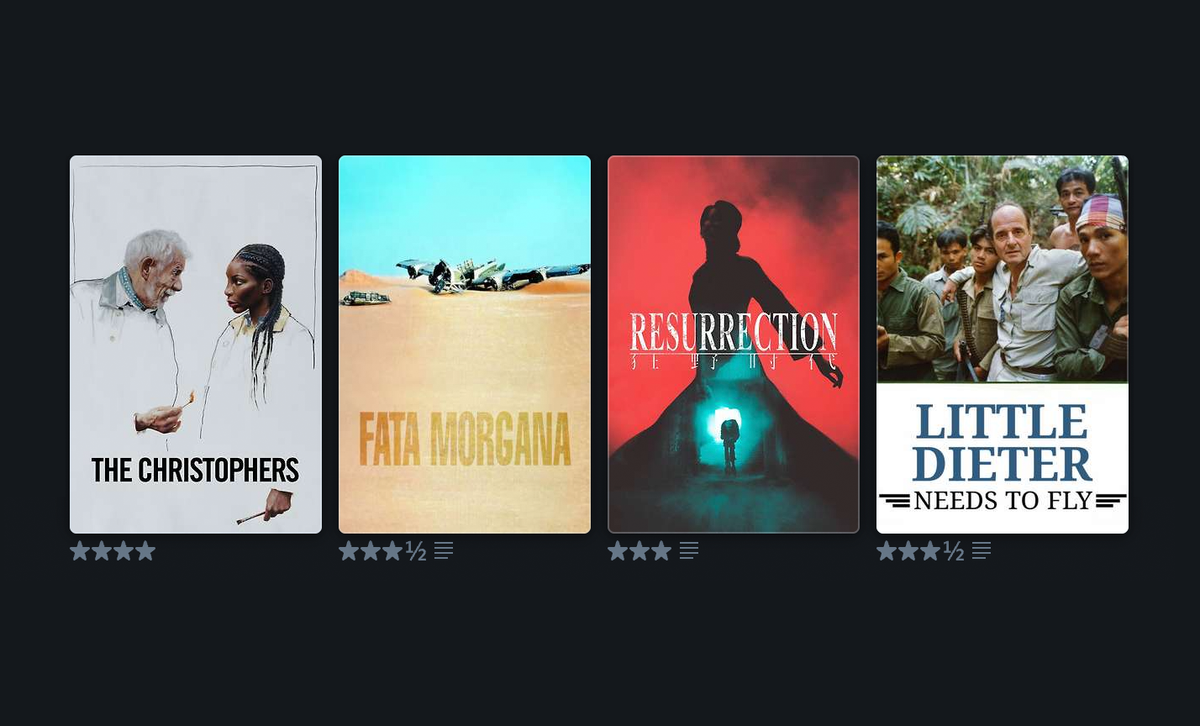
Steven Soderbergh's The Christophers //
Werner Herzog's Fata Morgana //
I tend to have a soft spot for movies that are like "here is some incredible footage" and refuse to either put it into a larger narrative or to overlay some point onto it that the footage isn't already making. (Examples: Castaing-Taylor / Paravel films, Frederick Wiseman films, "city symphony" films, Bill Morrison's Decasia, Kirsten Johnson's Cameraperson.) In my book, if you've got great footage (and maybe a decent editor), you don't need much more.
Fata Morgana here almost lands in the sweet spot. It has the great footage: mirages, corpses, ruins, outposts, faraway buildings, desert kids, lizards, fennec foxes. It wisely doesn't force any of it into a narrative but it does overlay the imagery: at first with a reading of the Popol Vuh and then later with a bunch of Leonard Cohen music. It's hard to know which of these choices represents the bigger grasp for Higher Meaning. Neither choice feels necessary and neither feels like it gives a good goddamn about whatever is happening on the screen. It's all captivating in a mismatched kind of way but you also can't help but feel like Herzog is hedging his bets a bit, which catches one off guard as he's not a man who really made his name by doing that. Watch the first two-thirds with the sound down? Or try to find a recording of the 2013 live score by drone metal band Earth that I just learned about from Wikipedia??
Bi Gan's Resurrection //
Undeniably ambitious, but I felt like I spent half the runtime trying to get on this film's wavelength. The grand metaphor about the Death of Cinema is pretty sentimental, and electing to enact that metaphor through an extremely handwavey science-fiction conceit is pretty silly. And the best segments of this film are, frankly, the ones where this metaphor and this conceit both get pushed to the back seat for a while. For instance, the unbroken-shot New Year's Eve segment is audacious enough that I could forget the scaffolding and just enjoy it, and it would have felt remarkable as a standalone film—but then when it gets fit back in to the overall contraption of the film's Big Goings-On it feels like it gets cheated out of some of the room it needed to breathe. Same goes for the segment with the monk and the spirit, and the segment with the con-artist and the orphan—either of those stories might have sustained entire features, and might have benefitted from a little extra air. (And the segments that rely the most on the Big Conceit—the needlessly convoluted noirish one and the faux-German Expressionist opener—really do feel burdened beyond the point of salvage.)
I don't think this wants to be thought of as just an "anthology film" but in the end I'm not sure that this avoids the trap that a lot of anthology films fall into: some of it is good, some of it is bad, the device that contrives to hold it all together shows signs of being a contrivance. Worth the watch and it gets better as it goes along, but I think some of the exuberant praise for this oversells it.
Werner Herzog's Little Dieter Needs to Fly //
I want to start by saying that Dieter Dengler's wartime capture, escape, and rescue makes for a gripping story as well as a compelling reminder that human beings can persist through unimaginable suffering, emerge out the other side, and find something that, for all intents and purposes, looks like happiness. I was never bored.
With that said: I was nagged, while watching this, by the sense there are at two ways that this film could be more compelling.
(1) Dengler himself is an interesting figure and his tale is worth telling, even worth hearing in his own words—but he is not an especially gifted raconteur, and he rattles through the details briskly and without much in the way of evident emotion. There's a strange fascination that comes with watching someone such an intense story so matter-of-factly (in a way, you could argue that this is a film about the power of compartmentalization). But it's hard not to imagine the power that the story could have were it relayed by a more emotive teller.
(2) Herzog's decision to bring Dengler back to Laos and re-enact portions of his captivity, forced march, and torture is an absolutely wild choice, and while it produces some tremendously dissonant imagery, no one actually seems especially interested in interrogating the choice. Dengler mentions in an offhand way that he agreed to it as a means of possibly putting some demons to rest, but we get very little about the process of who came up with the idea in the first place; how it was negotiated or arranged; whether there were challenges in implementing it; whether it had emotional fallout; or even whether it was successful at doing what Dengler hoped it would do. You can imagine putting this film in a repertory series on "the politics of re-enactment," but it has surprisingly little interest in engaging with those politics in a substantive way (to say nothing of problematizing its own choices). The offhandedness may be part the point (in a way, this is just "Herzog being Herzog") but I spent some time comparing this film against another documentary that it clearly helped to inspire—Joshua Oppenheimer's THE ACT OF KILLING. ACT OF KILLING is similarly based around the making of a traumatic re-enactment, but it lavishes a comparative surfeit of attention on the queasiest aspects of this work, with special attention devoted to how re-enactment can wreak havoc on the psychology of its participants, and I think it serves as a stronger and richer film for those exact reasons.