4/25-5/2
Richard Linklater's HIT MAN // Quentin Tarantino's DEATH PROOF // Paul Thomas Anderson's THE MASTER // Werner Herzog's THE GREAT ECSTASY OF WOODCARVER STEINER
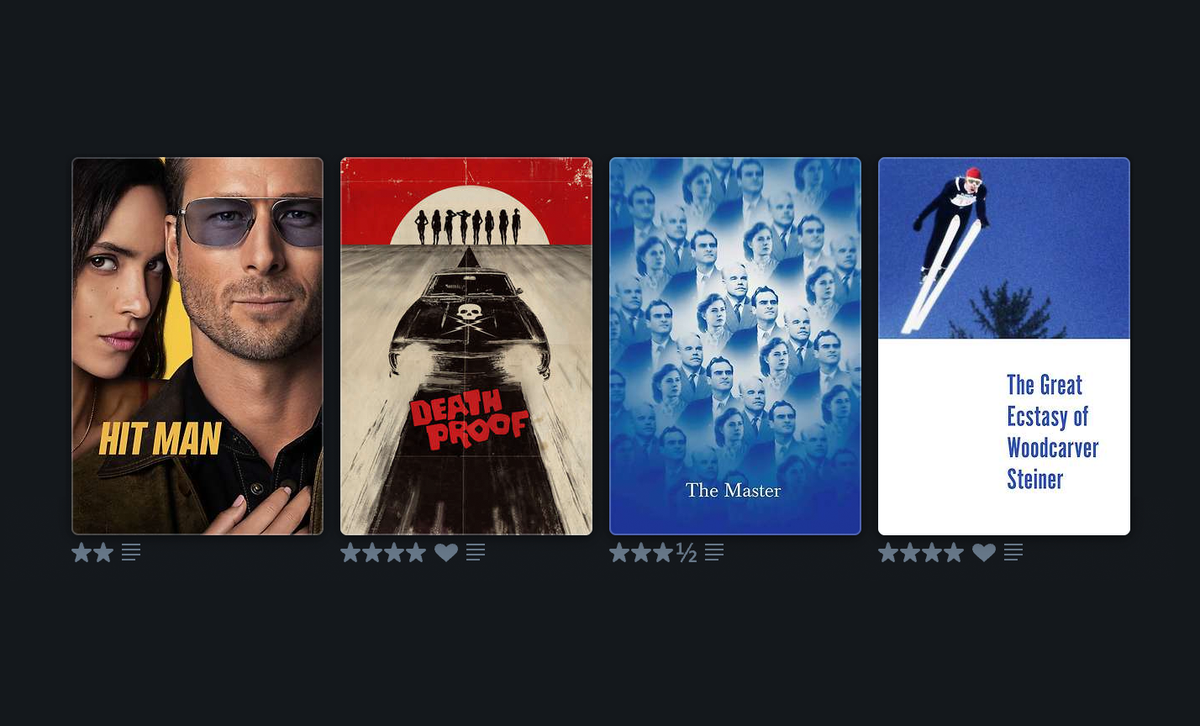
Richard Linklater's Hit Man
This one gave me the ick early on and I never quite got over it. "Cop leverages his undercover identity in order to have sex with a woman leaving an abusive relationship" is a kinda dicey premise and the overall copaganda vibe doesn't exactly smooth things over. Nor do the talky Linklater-y bits in the classroom (which make a halfhearted effort to sell this story as an exploration of deeper existential concerns). A movie can sometimes overpower its dicier elements with enough raw charisma (I'm thinking of, say, Pitt and Jolie in Mr + Mrs. Smith) but I'm straight-up not feeling that Powell and Arjona are anywhere near that level, despite the fact that this film clearly exists as a starmaking device for Powell specifically.
Quentin Tarantino's Death Proof
One of the greatest have-your-cake-and-eat-it-too maneuvers in the history of cinema: Tarantino makes a sleazy sexploitation film that, over time, refines itself (narratively, formally, and even materially) into a critique of his own sleazy tendencies and a ruthless takedown of misogynist masculinity more broadly. Plus it gets to geek out (endearingly) about car chase movies. Gets a little baggy in spots (there's no way this should be longer than, say, Reservoir Dogs) and there are a few instances where Tarantino still gives in to his own worst instances (the rapey joke about leaving the model-actress with the redneck feels both out of character for these women and out of place in the more "refined" half), but overall the film accomplishes more than being just the "grindhouse" pastiche it was marketed as.
Paul Thomas Anderson's The Master
I never know quite what to do with this one. The performances are outstanding—you could make the argument that both PSH and Phoenix are at the top of their respective games at around this time, and every scene with the two of them together is absolutely electric. The gifted roster of secondary cast members (Amy Adams, Jesse Plemons, Rami Malek, Laura Dern) turns in good work, too. And PTA's command of the image is as sure-handed here as ever: nearly every shot has something to recommend it.
But the script... well, the better Anderson films are scripted so that their pacing and intensity modulate carefully throughout their runtime before coalescing into a forceful finale. The script here starts out strong, but seems to grow becalmed in its final third. The narrative grows slack; the events make the same handful of points (Freddy is volatile, Lancaster is thin-skinned, Peggy is ineffectually vying for command); the motivations for why anyone is doing what they are doing grow more obscure and murky instead of coming more sharply into focus. The final emotional scene between Hoffman and Phoenix feels completely unearned, which is maddening given that it also somehow feels instantly iconic (tremendously shot, stunningly performed, indelibly memorable).
The person I watched this with said that they ignored the details of the story and watched it as though "watching something in a different language" and I ultimately feel like the film might feel more successful if approached that way: as a kind of raw sensory experience, absorbing, but with a certain layer of opacity that you'll never get all the way through.
Werner Herzog's The Great Ecstasy of Woodcarver Steiner
Look, either you like slow-mo footage of "ski-flying" jumps set to a Popol Vuh soundtrack or you don't.
Turns out... I do