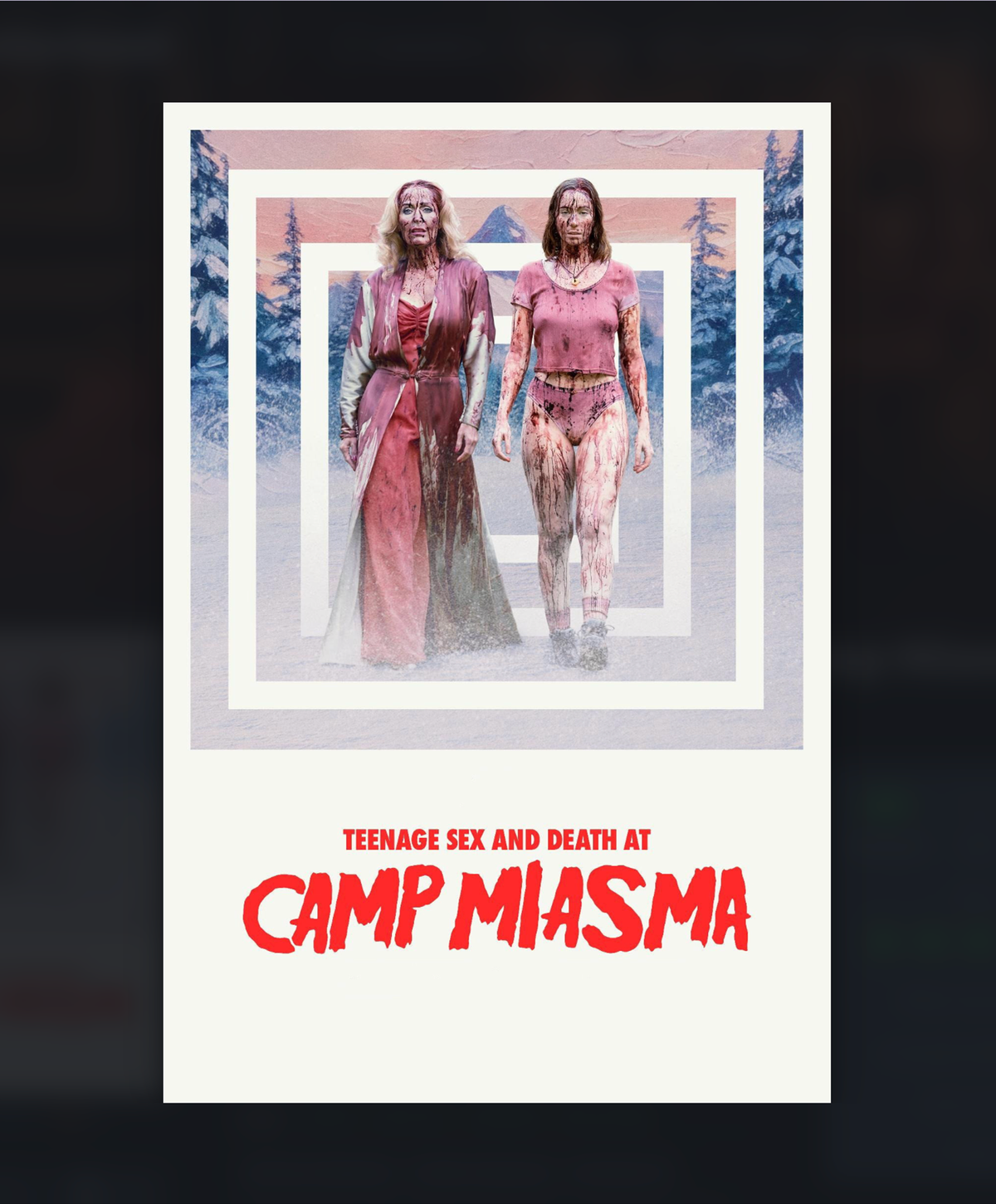
TEENAGE SEX AND DEATH AT CAMP MIASMA (2026)
This review may contain spoilers.
Jane Schoenbrun is one of the most consistently interesting filmmakers to have emerged this decade—I am a fan of I Saw The TV Glow (2024) and a (more qualified) fan of We're All Going To The World's Fair (2022), so this was probably my most-anticipated film of 2026. And, well, there's good news and bad. The good news is that this reveals Schoenbrun expanding their emotional range—it's the first of their films to be genuinely funny, and the first to marshal eroticism in a sustained, effective way. The bad news is that it's also the sloppiest of their films, and the least focused.
It makes for an interesting pairing with a movie from earlier this summer: Gregg Araki's I Want Your Sex. Although tonally very different, they have a rich set of similarities: both are thematically about the struggles with feeling, enacting, or embodying desire; both deal with cross-generational, BDSM(-ish) dynamics problematically arising within a professional(-ish) context; both contain homages to Sunset Boulevard (1950). Both also are structured with what I count as three distinct narrative strands. Here in Miasma those three strands are (a) a meta-referential, semi-autobiographical satire about a Sundance wunderkind rebooting the "zombie IP" of an out-of-favor slasher franchise, (b) a story of sapphic erotic awakening, in which a young woman estranged from her sexual identity is guided toward satisfaction by an older, more experienced woman, and (c) a fantastical tale about "where movies come from" which also involves a malevolent [?] transgender being that lives at the bottom of a lake. As with I Want Your Sex, no strand quite succeeds on its own merits, and only one strand really resolves satisfyingly. But Miasma moves less deftly between its strands, and the resonances are less salient—you can sometimes feel the gears grinding as we shift from one mode to the next.
It also contains at least one major sequence that doesn't fit neatly within any of these strands: we see much of the original 1980s Camp Miasma as a film-within-a-film, which pays great dividends for at least two of these plot strands, but we're also treated to a long setpiece wherein the killer, Little Death, murders a series of teenage campers, one after another, in a single shot. As a sort of fantasia of queer revenge, it provides a lot of immediate delight, but problems begin when you try to position it within the established ongoing narrative: it signals in multiple ways that it isn't a scene from the film-within-a-film (slashers from that era don't kill off their characters en masse, the continuous-tracking-shot technique wasn't prominent in 1980s low-budget horror cinema, the low-budget grainy look disappears and the CGI ramps up, and the needle-drop memorably soundtracking it is from 1996). So what is it doing here? It doesn't belong in the narrative, it doesn't advance the plot(s), it doesn't homage effectively, it doesn't spoof effectively. It's a showstopper moment, proving Schoenbrun's technical chops, but because it seems so divorced from the rest of the goings-on, its visceral catharsis felt pretty blunted for me.
Once you start to pick at the little bits that don't totally add up, it's hard not to notice more of them. For instance, Billy Presley (played with great aplomb by Gillian Anderson) is, we're told, the "final girl" from the original franchise's first film. And if you've watched enough of your 70s and 80s slashers (or read your Carol Clover), you know well enough that the "final girl," almost definitionally, survives her encounter with the killer—she witnesses the worst violence, registers the most horror, but then fights back and often defeats the killer. I don't mean to cast doubt on Schoenbrun's understanding of the material—far be it from me to play the "I appreciate slasher movies on a much deeper level than you" card—but it does strike me as a significant misjudgment that we don't see Presley's character, Squeak, enact any of these "final girl" tropes (it is, in fact, strongly implied that she is killed in a dual kill, just as Hannah Einbinder's Kris, standing in for Squeak, is killed in her own climactic fantasy near film's end). Kris wants to fantasize about being a "victim" (legit, tbh) but how is this identification complicated when your fantasy figure overcomes her own victimhood? This film doesn't say or even evince much interest in the question.
And there's undeniably something compelling about the symbolic valence of the "thing in the lake" being somehow the generative force from which movies emerge, but we're told forcefully by Kris that this isn't supposed to be a symbol (or metaphor, or allegory). So—if we take Kris at her word, then—what is it? Is it something we're supposed to take literally, as a truth about the universe these characters inhabit? If so—how does that work, exactly? If this is where "movies come from," why do we see a movie descend into the being's lair, instead of seeing a movie come forth from it into the world? Or are we just supposed to be taking this as Schoenbrun's abject self-insert? I was pleased to clock the Videodrome homages in this strand, but the film had started to groan under the weight of its own meta conceits, and by the time a black-and-white Patrick Fischler was materializing grainily at a gas station doing his Mulholland Dr. reprise for a second time, I was pretty ready to check out.
I still think Schoenbrun is a filmmaker of abundant talent, and I'm happy to see them broadening their reach. Yes, this film has too much to say, but I'd rather watch that than watch a film that has too little to say—even though there's a lot here that failed to connect with me I was glad to see it taking its swings. In the end, though, nothing really gave me more delight than the opening credits, which establishes the rise, fall, and rediscovery of the fictional franchise with great wit and an attention to detail that the rest of the film could have used more of—special praise, then, for titles designer Mila Matveeva, who has been credited, at least in part, for that sequence.