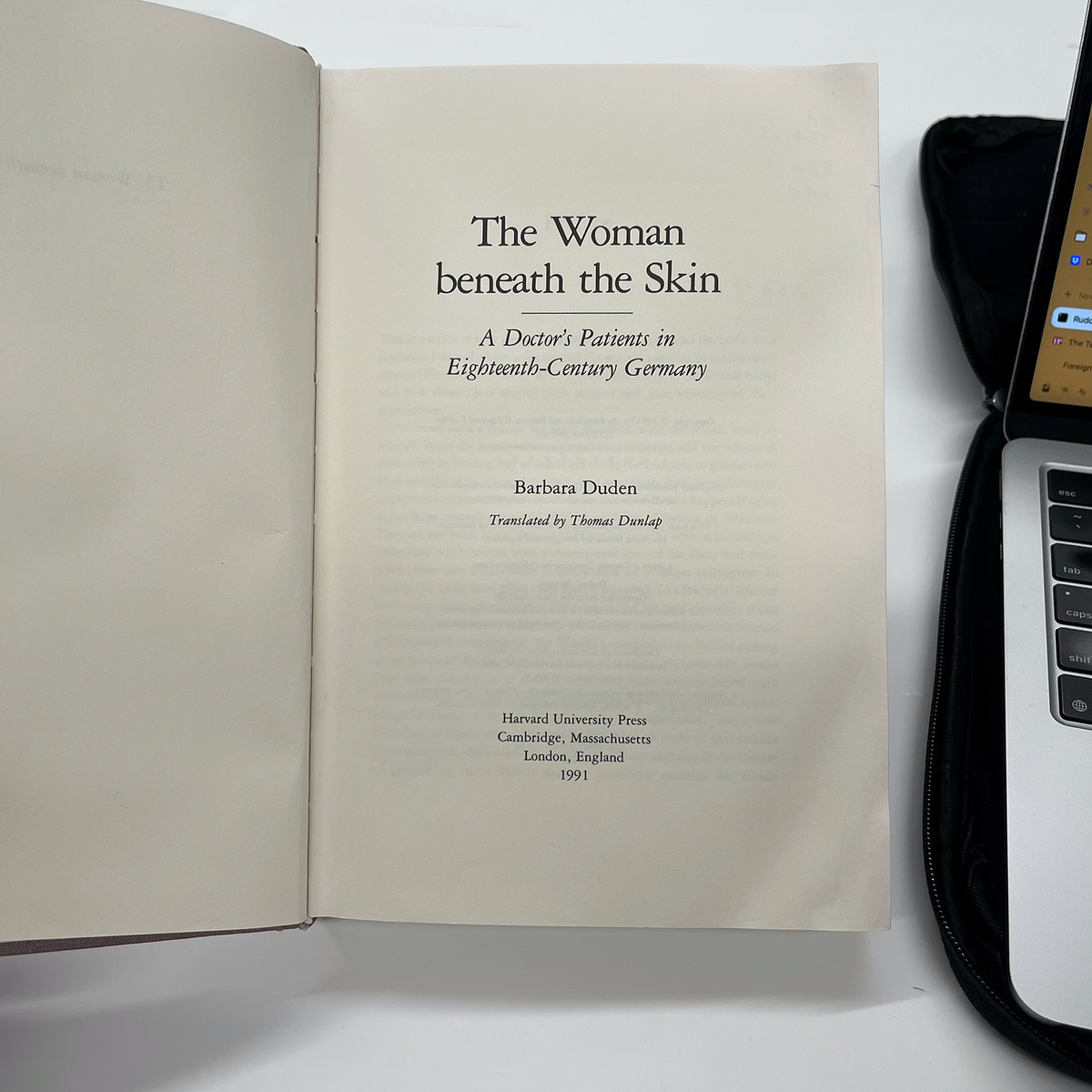
Barbara Duden's THE WOMAN BENEATH THE SKIN
Notes [oldest to newest]
1. George Duby's "total sphere of history"
2. The presumption of an "evident" body
3. The origins of the "modern body"
4. Perspective and the art of fencing
5. "Professional distortion of the body"
6. Bachelard and "the imagination of matter"
7. The "history of corporeality"
9. The loss of the body's "social vitality"
11. The "body aura"
12. The "cultural hierarchy of the senses"
14. The flowing body
16. Medically defined "health"
19. The Scientific Revolution's view of "nature"
22. Reproduction and "the context of production"
23. de Sade and modern sexuality
25. G. E. R. Lloyd
27. Breathing, smell, and sight
30. Rudolf zur Lippe
31. On nakedness
33. Concealed bodies and bodily phenomena
34. The obsolete language of the experience of pain
35. What the sick of the past wanted from their doctors
36. "External flows" and "inner processes"
37. The eighteenth-century understanding of sex differences
38. Corporeality, culture, and sexual differentiation
39. "Unstructured osmotic space"
40. Motus and tonus
41. "Inner flux" and "outer flux"
42. Noncorporeal causes of illness (in the past)
43. Sufferings "stuck" in the body (in the past)
44. The experience of personal body pain, then and now
45. The modern objectified body vs. the body of the Middle Ages
46. Our sense of womanhood is confined by history