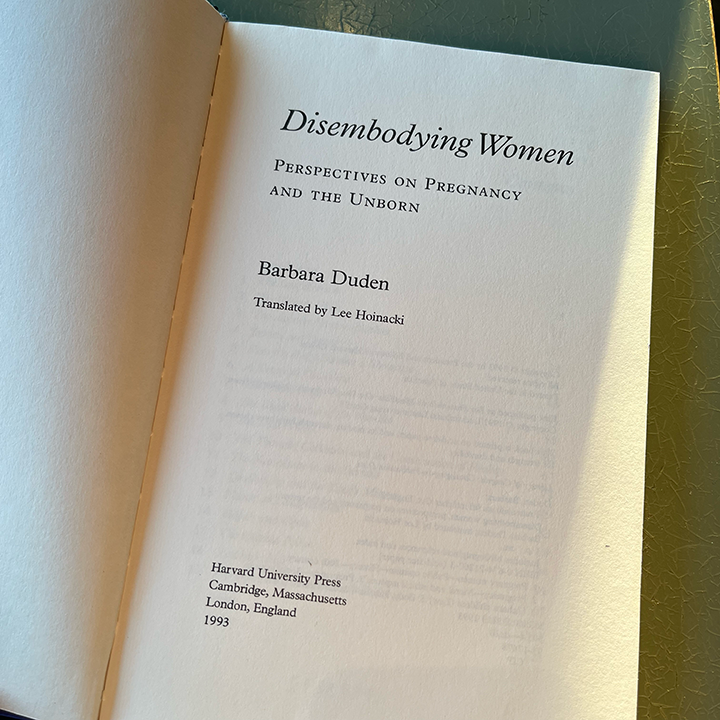
DISEMBODYING WOMEN: PERSPECTIVES ON PREGNANCY AND THE UNBORN
short bluesky summary
⌘ Duden is interested in three things: how it feels to live in a body; how it FELT to live in a body, historically; & the contemporary scientific apparatus that delegitimates these perceptual forms of (self-)knowledge
⌘ put another way: today, a pregnant person "knows" (or rather is told) that they are pregnant because a perceiving machine "sees" it. the machine is an extension of a medical, social, & legal system and its function is to make the pregnant person (& the unborn life) visible/legible within that system
⌘ for Duden, it is wrong to see either the machine or the system as natural or inevitable. they can be historicized—which allows us to analyze how they serve ideology (and function as power) and to interrogate whether they have the pregnant person's best interests at heart (spoiler: Duden thinks "no")
■ ■ ■
Notes [oldest to newest]
1. The socially constructed fetus
2. How flesh feels (across history)
3. Foucault's "think differently"
6. Leonardo da Vinci and the anatomical drawing
7. The experience of being in a psychophysiological system
9. Uwe Pörksen's "amoeba words"
13. Historical "orientation" in the body
14. Women's flesh as a public forum
15. Duden on "life"
18. A historical epistemology of ecology