24/7: LATE CAPITALISM AND THE ENDS OF SLEEP
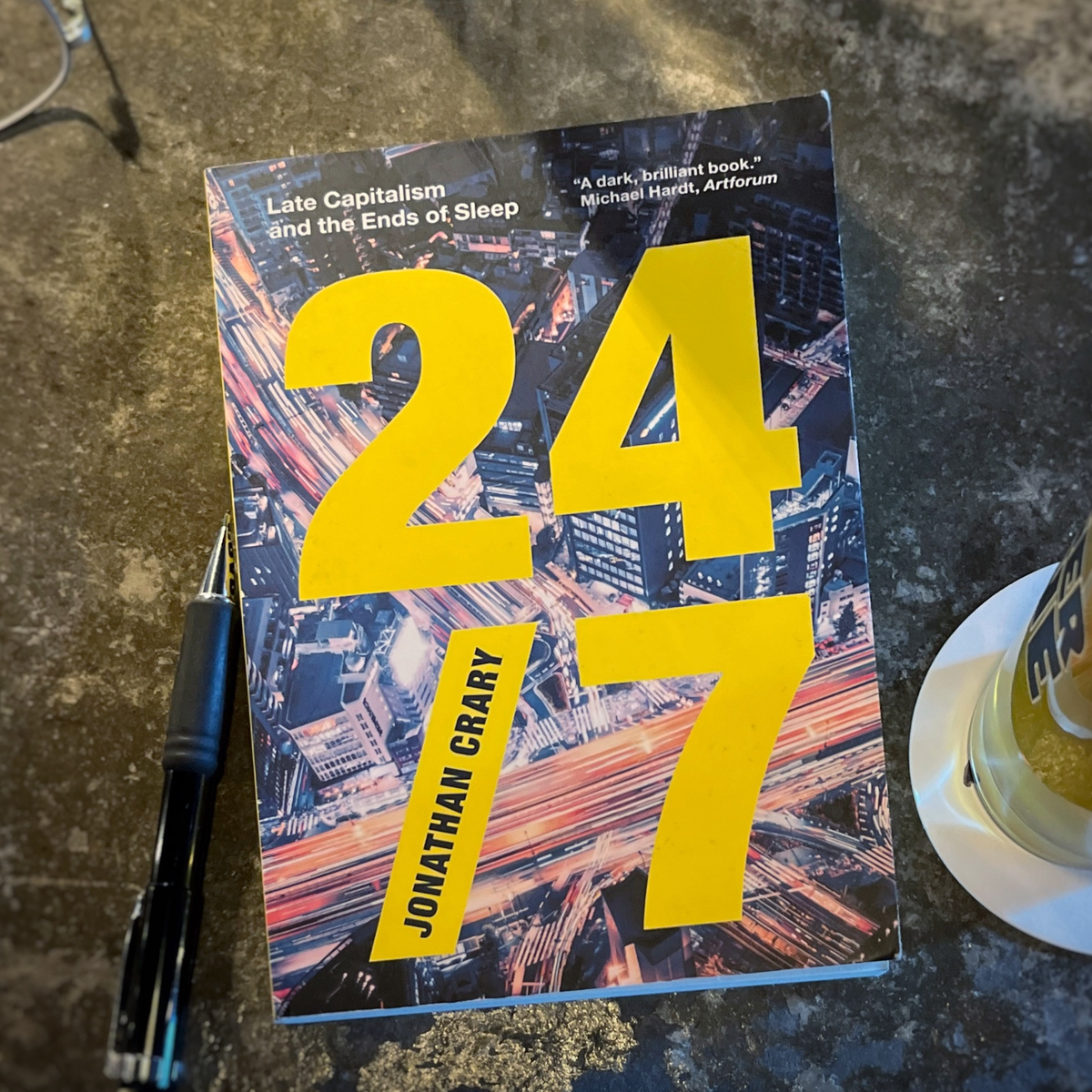
short bluesky summary
⌘ Capitalism with no "off" switch creates an exhausting world of informational flows which demand constant engagement and management. True on the face of it, but Crary won't acknowledge that these flows also can yield joy and delight
⌘ In other words, the book badly needs a theory of pleasure
⌘ Crary's argument is simply that we're in a straight-up ongoing nightmare, and the critique is bracing, but I also feel that he overplays his hand, that he flattens the moment in his attempt to describe it
⌘ All evidence suggests that people really do enjoy sharing, remixing, curating, reviewing, and discussing media—does Crary see them as so many brainwashed capitalist dupes, victims of false consciousness? He doesn't say, perhaps because it would run the risk of sounding profoundly patronizing
⌘ Somebody like Henry Jenkins suggests that there's cosmopolitan pleasure to be derived from access to exploring the actions and choices available to us in the current cultural sphere. I DO think Jenkins's ultimate implication that this constitutes a liberatory act overstates in the other direction—
⌘ —but I think that the truth of the matter lies somewhere between the poles represented by these two thinkers, that all of us from childhood on navigate our relationship to the incessant flow of capitalized phenomena with at least a partial awareness of both the pleasures and the dangers
⌘ In a long-ago blog post, @fraying.bsky.social argues that it is wholly possible to rationally navigate an ongoing bargain with social media: "You are not the product. You’re a smart person making an educated decision about which companies you trust with your time, attention, and contributions."
⌘ so… yes, exposure to endless flows of media is corrosive and numbing, and platforms are extractive and exploitative, but these things also provide novelty, delight, connection, expressive capabilities, publicity, and more. Most crucially, we have *agency* in assessing when the bad outweighs the good
⌘ and I say this as someone who quit twitter, left substack, and have reduced instagram use to a bare minimum, but who uses ghost, loves bandcamp, and just paid for a letterboxd pro account.
■ ■ ■
Notes [oldest to newest]
5. The contemporary necessity for vigilance
6. Exposure, otherness, and care
8. Prescient early industrial capitalists
9. Power and reality in the information age
10. The outer limits of human disposability
11. The disabling of cultural memory
12. Accelerating patterns of acquisition
13. Agamben on technological control
15. Human needs vs capital's needs
16. The "homogenization of perceptual experience"
17. The benefits of "primordial narcissism"
18. Visual culture's remaking of attention
19. The death of spectatorship
20. Consumption patterns and drug users
22. Institutional forms of routine
23. The theorization of "everyday life"
24. Deleuze's "societies of control"
25. The death of non-capitalist novelty
26. Television, time, and place
27. Television, power, and agency
28. The Cornell television studies
30. Daydreaming under capitalism
31. Surrealist poet Robert Desnos
32. The decline in the study of dreams
33. 1968
34. Harold Bloom's "real American religion"
35. The destruction of alternate forms of living