WILD AT HEART (1990) ★
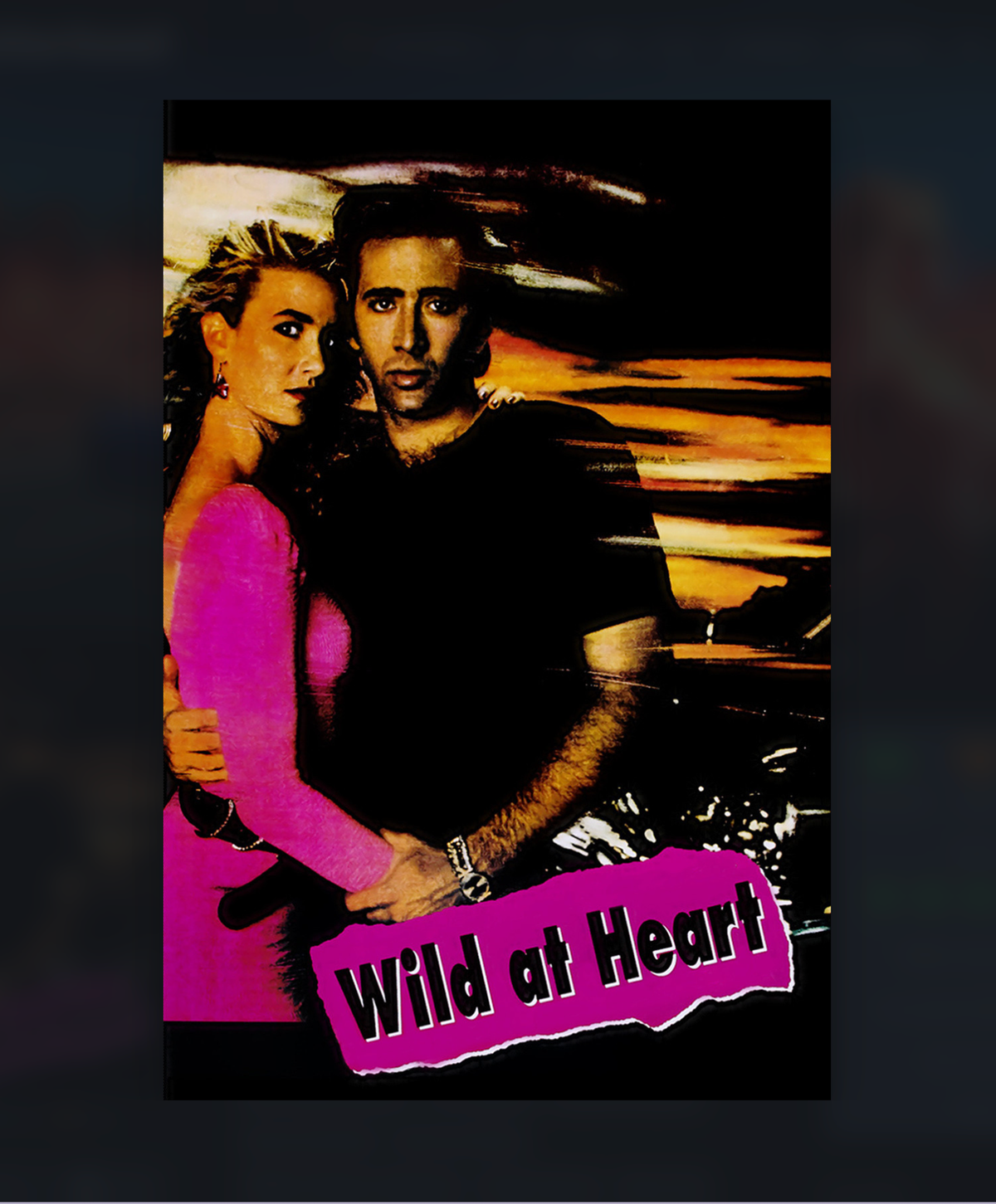
This review contains mild spoilers.
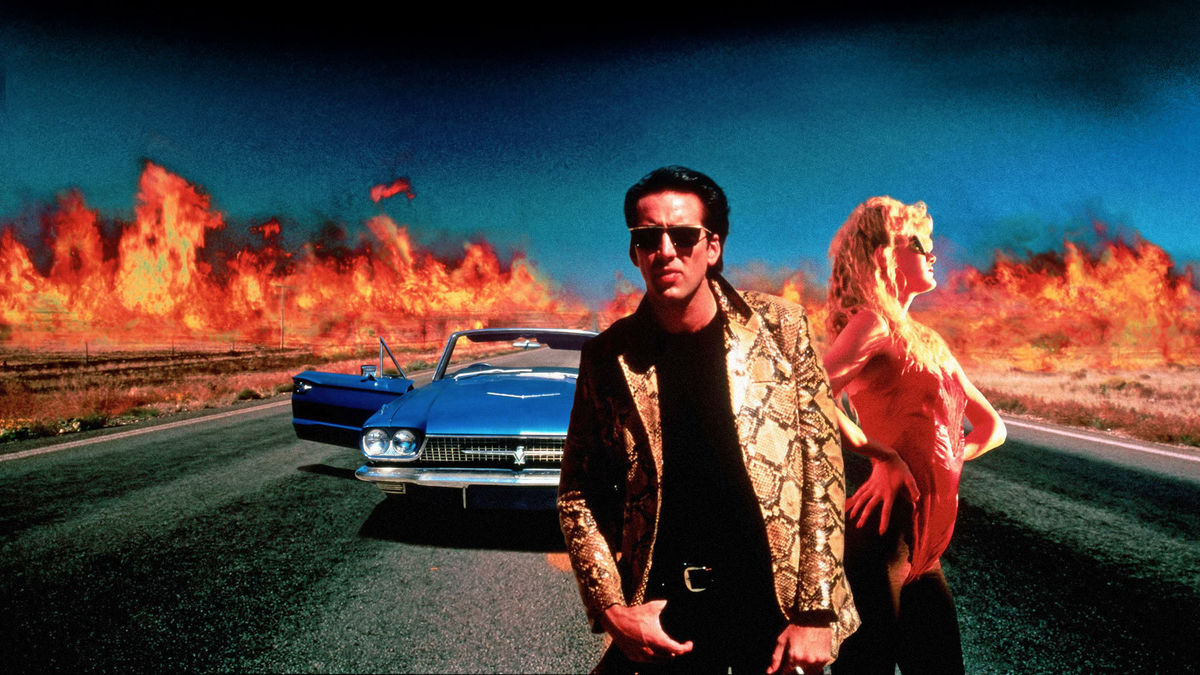
In the summer of 1990 I was a seventeen-year old Lynch fan (I'd seen Blue Velvet and was an avid Twin Peaks watcher). And so, just before starting college, I went to see Wild at Heart in the theater and it lobbed a Molotov cocktail of sex, violence, and uncut weirdness into the wide-open window of my brain. This was probably the most receptive I've ever been to everything a film had to offer. (In the first ten minutes alone you have billowing flames engulfing the entire screen, a dude getting his head smashed open, speed-metal guitar riffs on the soundtrack (2x), a scorching sex scene between Cage and Dern, and a child-rapist dying in an exploding car.) I would go on to see the film two more times in the theater before the summer was out, and I carried all three ticket stubs in my wallet for all of freshman year.
Nearly 20 years later, I would read Martha Nochimson's insightful book The Passion of David Lynch, which provides a sort of skeleton key for reading Lynch's characters and images as representations of wild energies (both good and bad) flowing through the universe and interacting with stabilizing forces (generally benign) and mechanisms of control (generally malevolent). Seen through this lens, Wild at Heart, with its motif of uncontrollable fire, is something of an "odd man out" in Lynch's filmography: it is the one that Runs Too Hot, with nearly every major and minor character revving dangerously, riding on impulse, with nothing in the world capable of cooling them down. Diane Ladd, magnificent as Marietta, the film's titanic villain, is a great example of this, tightly coiffed but a model of evil appetites and failing control—the scene where she rubs lipstick all over her face is the most indelible instance of her overflowing her emotional reserve, but she does some version of it in nearly every other scene. Willem Defoe and J. E. Freeman (rounding out the film's terrific rogues' gallery as Bobby Peru and Marcello Santos) give magnetic performances defined by coiled, purring menace, but they too erupt uncontrollably at the first provocation.
Consider, also, the many memorable bit characters here who flame out violently: Sherilyn Fenn babbling incoherently about hairbrushes and purses as she bleeds out on the ground; Crispin Glover reaching quiveringly toward a grid on the floor and screaming in anguish before he is swept into oblivion; Jack Nance appearing for a moment to bark like a dog. Harry Dean Stanton plays the film's one humble, kind, emotionally regulated human (detective Johnny Farragut), but his energies are clearly ineffectual in this landscape, and the moment he crosses paths with his counterforce (a vividly uncontained Grace Zabriske, trembling and shrieking in murderous ecstasy), you know, just as he does, that it won't end happily.
Our protagonists run too hot as well: yes, Sailor and Lula charm us with their sexual energy, their dance floor energy, their Elvis numbers, their momentum across the map, but their impulses are also overbrimming, reckless. They point only one way: into peril. (It's worth remembering that when Lula bitterly remarks "This whole world's wild at heart and weird on top," she intends it not only as a critique of their circumstances but also as a plain rebuke of their own foolishness.) The film's middle section holds them in meaningful check in Big Tuna, but their energy hasn't been reformed or channeled toward goodness, it's simply been left to stagnate, like the uncleaned day-old puke in their room. Nowhere to go but down. Lynch's films often supply a figure of universal goodness that reforms the characters and helps them find a path out of hell—and while this one does too, it arrives only at the last possible second.
Since Lynch's passing, in 2025, we've had an opportunity to do some reassessment of his output, and I think the general consensus is that his collaborations with Barry Gifford (this, two episodes of Hotel Room, and Lost Highway) are among the weaker entries in his body of work, representing a sort of mid-career longueur. And I can see the argument for passing over Wild at Heart, or treating it as a kind of embarrassing sibling to both Lynch's provocative early features and to his more mature later work. Certainly the overabundance of volatile energy here can spill over into just throwing out stuff for shock value. And, yes, some of it, here in 2026, is plainly cringeworthy: Sailor drops a needless homophobic slur; some fat sex workers are paraded out for us to gawk at briefly; the Black characters are presented in especially retrograde fashion (Lynch's representation of race has never been especially good, but having a white protagonist beat a Black man to death in the opening moments of this film approaches a career low, casting a pall that doesn't dispel as easily as Lynch (or Gifford?) might hope). But this is really the film, more than any other, more than Twin Peaks, that made seventeen-year-old me a Lynch fan for life, and all these years later I remain profoundly receptive to any film that can present a steady stream of cinematic treasures—unforgettable images, characters, lines, moments, erotic jolts, fields of luscious color—in a package that also engages with the lowbrow, distasteful, disreputable, sentimental, and ridiculous.
 jbushnell