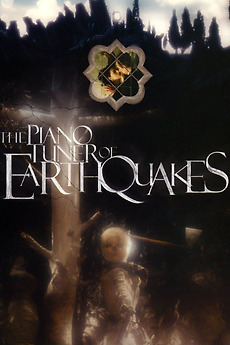
THE PIANO TUNER OF EARTHQUAKES (2005)

A Jungian looking at this might note that it's built around the interplay of four sturdy archetypal characters: a humble, good-hearted craftsman; an imprisoned, suffering beauty; a patriarchal malefactor; and a... horny matron? (You know, I don't hate it.) And a Freudian looking at this might note its thematic fascinations: uncanny automata, traumatic speechlessness, reenactment and repetition, "sexuality" more than sex. This abundance of charged material leaves the film feeling suffused with capital-I Import, though it can also build up into a smotheringly heavy atmosphere (one begins to understand why the Quays gravitate so frequently to adapting the writing of Bruno Schulz — his junk-shop hermeticism gives off just as potent an energy as all this psychoanalytic-flavored stuff, but his work also provides a needed streak of absurdist wit which is largely lacking here). It probably doesn't help that the dialogue is so low in the sound mix (at least in Metrograph's streaming version): making your audience crane forwards to catch each hushed, gnomic utterance isn't exactly the same as holding them captivated. You almost wish that the film had been silent, as so much of their work is: everything here looks marvelous (with special attention paid to peculiar qualities of light and shadow) and the primal basics of the narrative make perfect sense through the visuals alone. Oh, and the animation sequences are as compelling as ever, though I could have used more of them.
 jbushnell