COYOTE VS. ACME (2026) ★
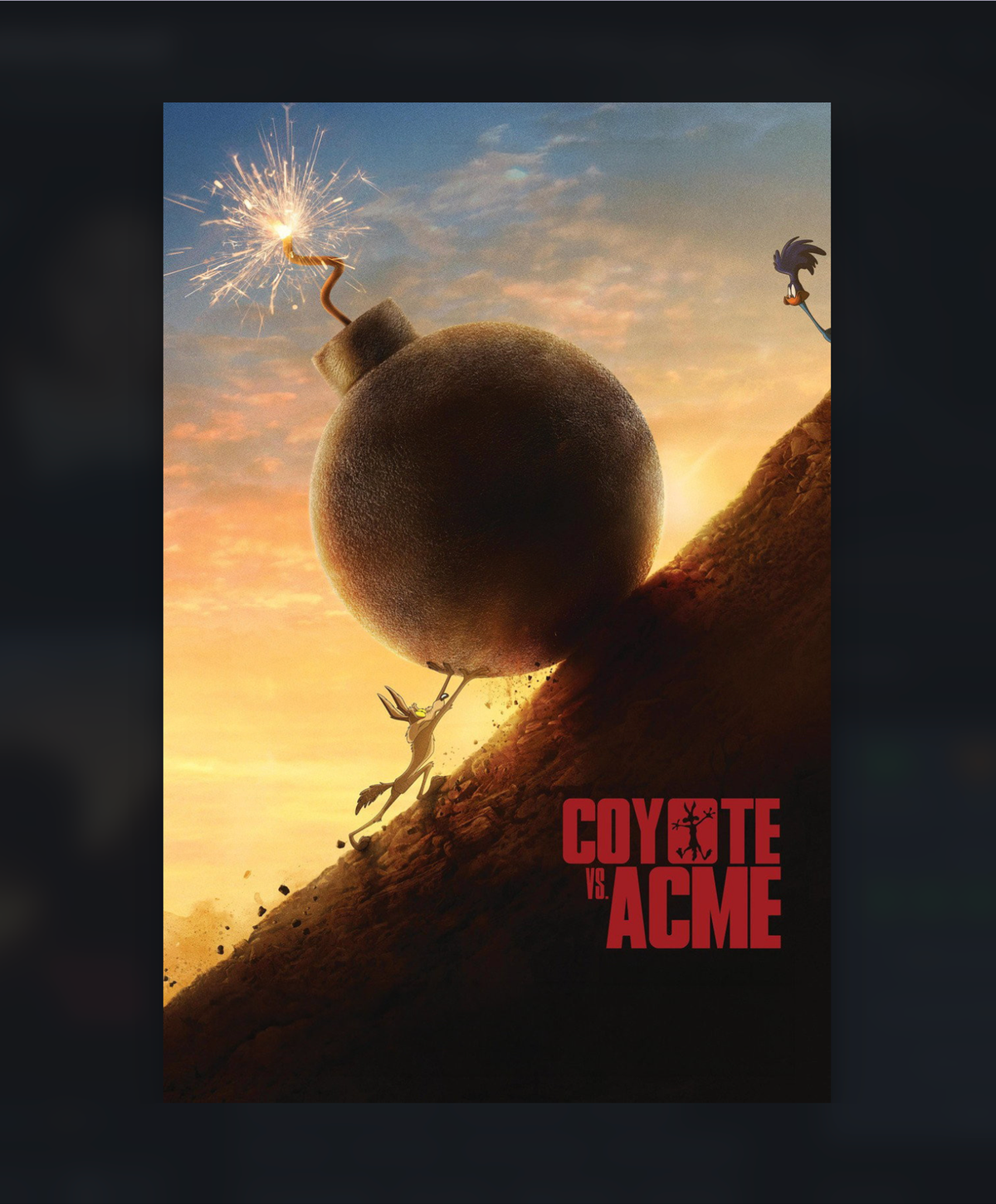
This review contains mild spoilers.
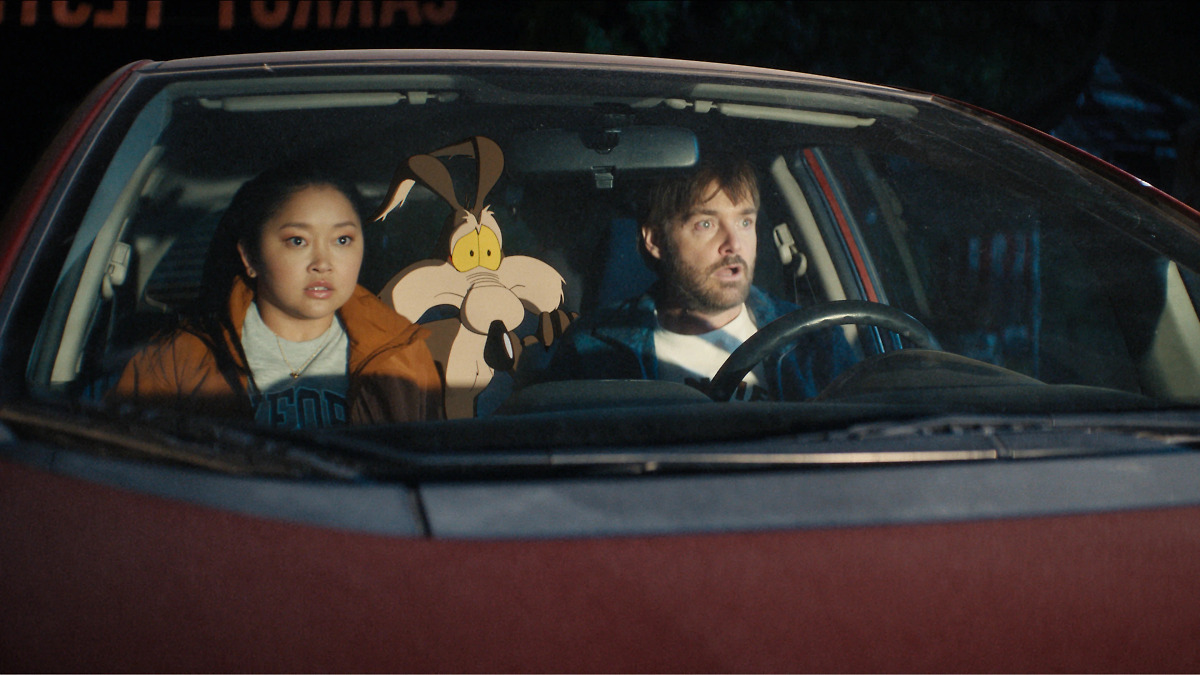
It's a common observation that old cartoons have sadistic qualities, but, aside from maybe getting yucked out by Pepe Le Pew, we don't usually take up the reasonable follow-up question of whether that sadism is occurring within a consensual context. One of the many things I could credit Coyote vs. Acme with is that it made me... think about this? I'll stop short of saying that this film canonically establishes that Wile E. Coyote and the Road Runner are in a BDSM relationship, but I will point out that, in its final act, it makes insightful distinctions between a (special, good) kind of violence that emerges from mutual play between affectionate partners and a (more common, bad) kind of violence that emerges as the impersonal consequence of the successful operation of an alienating capitalist superstructure. (It also points out which of these forms of violence leverages its legibility to integrate with the apparatuses of power.) This might sound like a ridiculous line of thought, but before you judge me too harshly, take a moment to remember that the screenwriter here, Samy Burch, also wrote May December, another (very good) film deeply interested in power, violence, and consent.
Burch concocted the story with assistance from James Gunn, and if we can credit Burch for the thoughtfulness with which the film handles the dynamics of violence and power, we can probably credit Gunn with the deftness with which the film handles its intellectual property. Like the Muppets, the Looney Tunes characters inhabit a sort of unusual cultural niche nowadays—we should rightfully acknowledge they're past their prime, and we could go further and say that the specific forms of entertainment they are best remembered for making really no longer even really exist in the 21st century. However, the culture at large maintains a kind of appreciative recognition of them, and there are of course a subset of people to whom the characters matter deeply (I'd count myself in this latter group: Looney Tunes were a staple of my childhood media diet, and I had a special love for the Road Runner shorts in particular).
Obviously, making a film with these characters that pleases both of these constituencies is difficult—too much fan service and you drive away casual viewers, too little and you run the risk of stoking toxic backlash from the die-hard fans. Gunn has a good track record of pulling off this particular kind of balancing act, though: he is a writer and director known for having a genuine love for the specific tropes, textures, and iconography of old comics and outdated cartoons, while also possessing the ability to repackage them in a form palatable to mainstream audiences. So taking an entire generation of hoary old cartoon claptrap (falling pianos, rocket skates, portable holes, etc.), liquifying it, and pouring it into the mold of a legal thriller is a trick that works reasonably well. (It's not exactly a new way to solve the problem of how to use these characters, of course: Space Jam does it by using the form of the sports comedy, and Who Framed Roger Rabbit, still the best of all films of this type, does it with the form of the California noir.)
So it all basically comes together. The film is smarter than you'd expect, the gags land more consistently than you'd think, and the deep references for fans spark joy without ever making the whole film feel like it's just mining nostalgia. Forte and Cena are (unsurprisingly) more than game and Martha Kelly's deadpan energy is always welcome (I've had a soft spot for her since her role as Agent Harrington on Common Side Effects). Kudos to the campaign that rescued this film from tax write-off hell.
 jbushnell