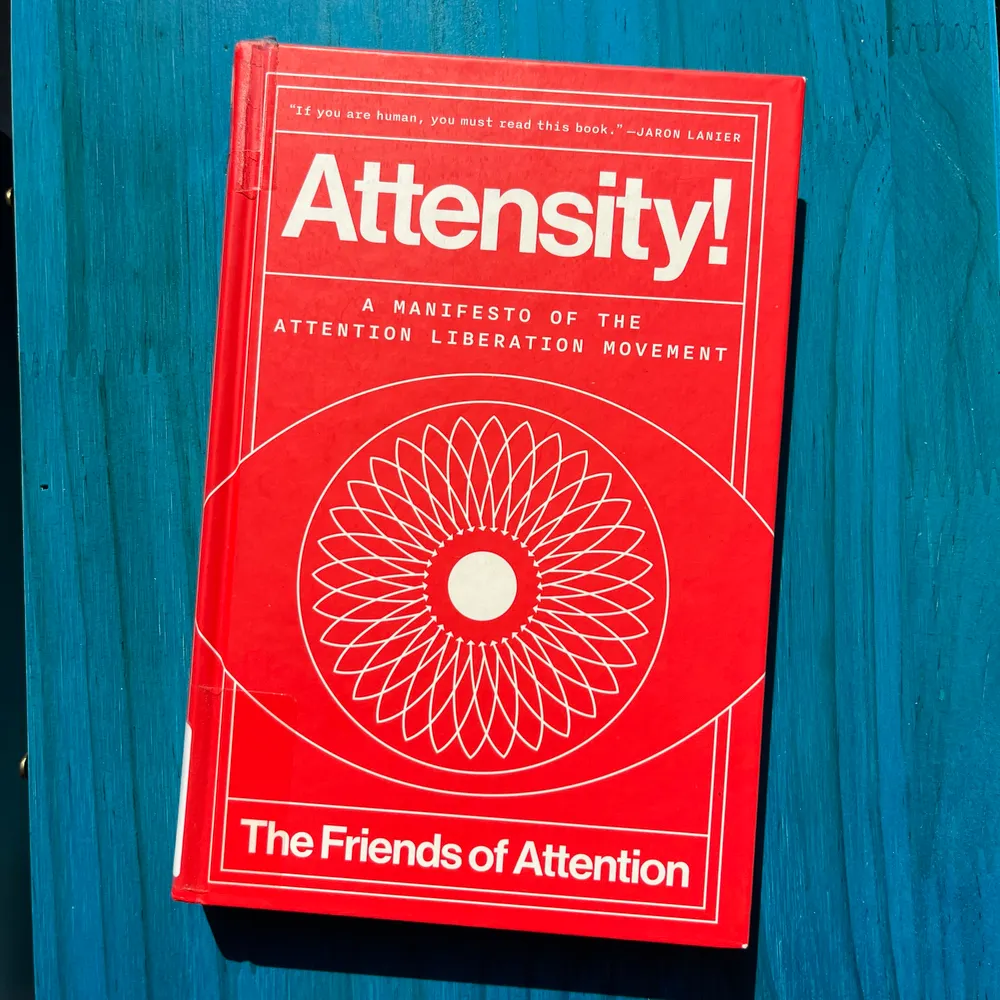
ATTENSITY! A MANIFESTO OF THE ATTENTION LIBERATION MOVEMENT
short bluesky summary
⌘ In a recent newsletter, @katewagner.wehwalt.net expresses a weariness with the "'I gave up my phone' essay," in which "analog warriors" inveigh against “Screen Time Capitalism." This reads a bit like that type of essay expanded to book length
⌘ That's not to say that the argument doesn't benefit from having some expansion, exactly (having a bit more room to explore the history of, like, military-industrial studies of attention, human factors research, etc. adds useful context to this familiar ongoing struggle, for instance)
⌘ if you were new to the topic or if you wanted the rallying bravado of a manifesto structure, this could well be the book for you! but I have to grant the point that this territory feels a bit well-trod (Wagner's piece mentions Jenny Odell's resistance text HOW TO DO NOTHING, which came out in … 2019)
⌘ "attention frackers" is the phrase the Friends of Attention use to define their enemy, and ultimately this just means the tech barons who run Phone Capitalism, which ends up putting the Enemies of Attention into something of a small tent...
⌘ ...and everyone paying attention to anything OTHER than phones is in the big tent of good guys. "There's more of us then there are of them" is stirring rhetoric, but when the tent becomes big enough to explicitly include Gamers and Fans I start to wonder if it isn't beginning to lose its utility
⌘ Like if you look at certain contemporary frontiers of game design or fandom management and see anything other than a severely "attention-fracked" landscape I'm really not sure you're looking closely enough
⌘ (put another way, I'm not sure why giving attention to CANDY CRUSH SAGA is good, but giving attention to, say, Facebook is bad)
⌘ Near the end of the book their logic leads them into concluding that much of what appears as "distraction" could actually be said to be a form of "unauthorized attention," but this muddies the waters even more. Is distraction only bad when someone is profiting?
⌘ They describe this as a "paradoxical provocation," and argue, maybe fairly, that their inability to think their way out of it derives from the fact that "our language for talking about our attentional lives is not especially well-developed"—but shouldn't writing a book on the topic help with that?
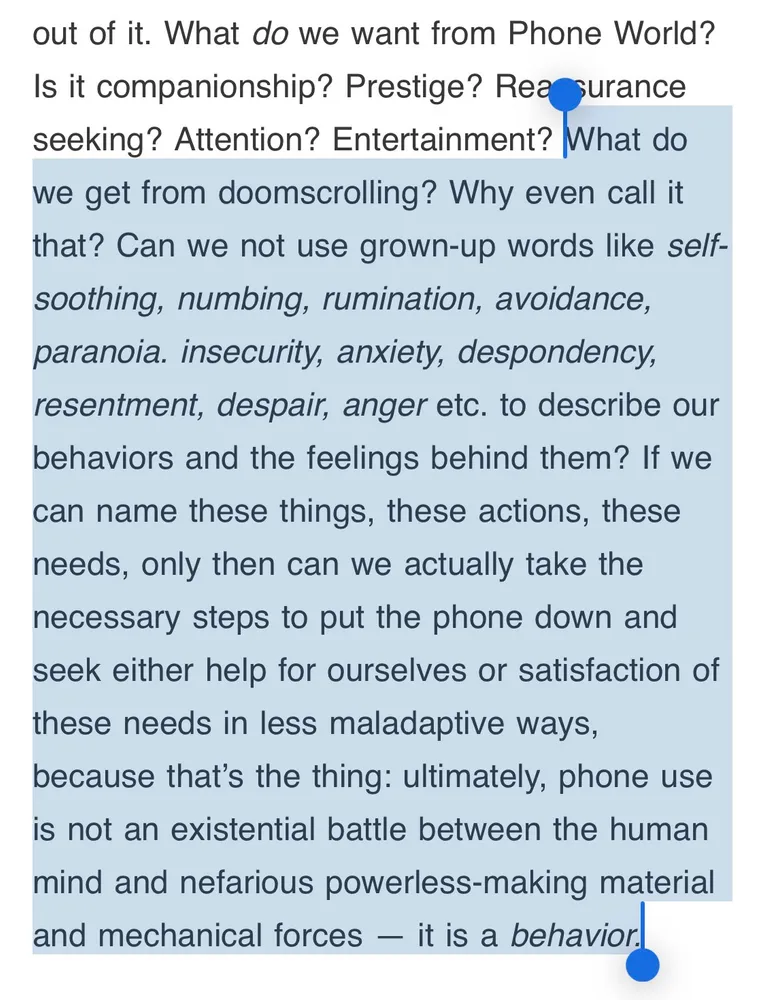
⌘ A genuine contribution to talking about our attentional lives comes again from Wagner, who exhorts us to not only consider our phone usage but, more importantly, "what we get out of it. What *do* we want from Phone World? Is it companionship? Prestige? Reassurance seeking? Attention? Entertainment?"
⌘ This reminded me of my thoughts on Jonathan Crary's 24/7: LATE CAPITALISM AND THE ENDS OF SLEEP, a bracing critique that also inadvertently flattens some of the richness of our attentional lives and strips us of attentional agency
⌘ I'll close off for now with one last salient Wagner bit (too long for one skeet) and a link to her (substack) piece, which is worth reading in full
■ ■ ■
Notes [oldest to newest]
3. "Muses of the attentive spirit"